
A Structural Shift Is Redefining How Retail Scales
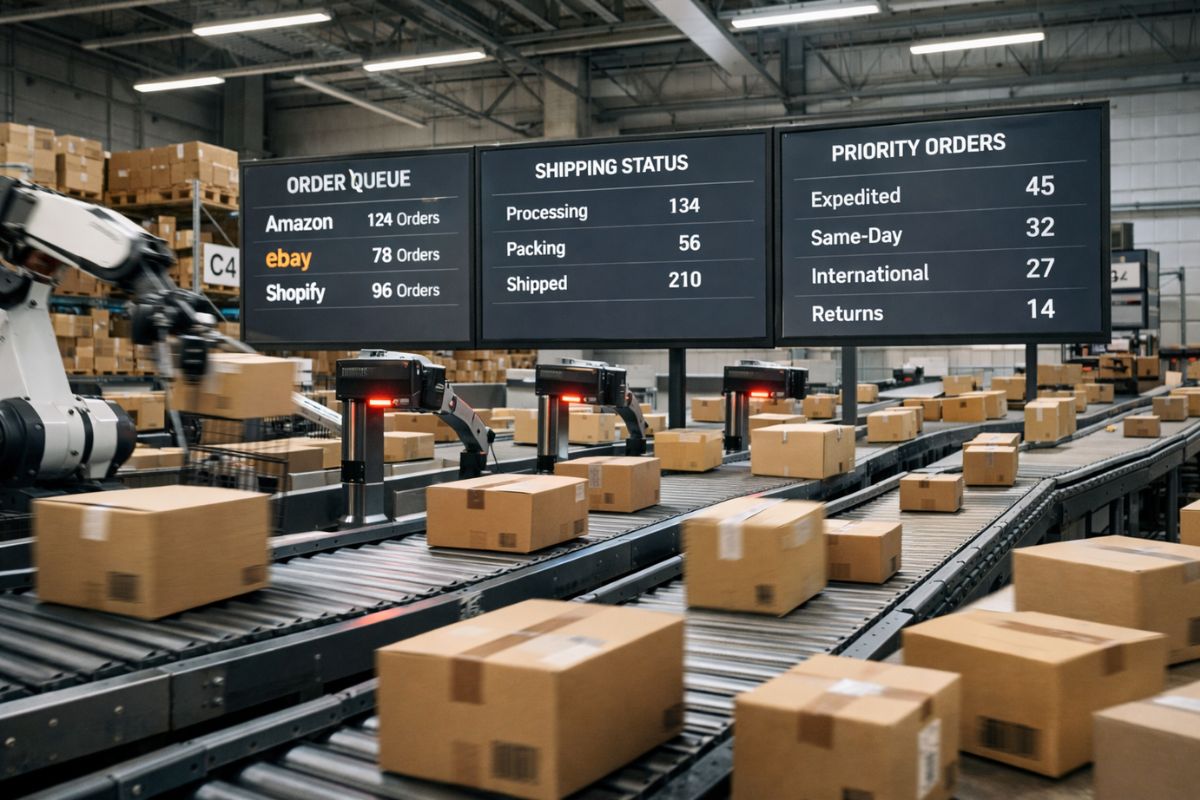
Retail is entering a decisive period of operational redesign. Across North America, businesses are quietly relocating inventory away from owned warehouses and into shared marketplace fulfillment ecosystems that manage storage, processing, and delivery. What began as a tactical response to ecommerce growth is now evolving into a platform driven logistics model that is reshaping cost structures, distribution strategy, and competitive positioning.
This is not simply outsourcing. It is a reallocation of capital and control toward infrastructure that behaves more like a network utility than a proprietary asset.
Organizations that understand this shift are gaining access to scalable distribution without the financial burden traditionally associated with expansion. Those that do not risk anchoring themselves to an operating model that is increasingly misaligned with digital commerce realities.
From Asset Ownership to Network Participation:
For decades, retail growth required physical accumulation. More stores meant more backrooms. More orders meant more warehouses. Expansion demanded significant investment in real estate, labor, inventory systems, and transportation capacity.
Marketplace fulfillment ecosystems invert this equation.
Instead of building logistics capacity internally, businesses now plug into shared networks that aggregate inventory from multiple sellers, coordinate warehousing through advanced software layers, and execute last mile delivery through distributed carrier relationships. These ecosystems transform logistics from a fixed cost center into a variable service aligned with demand.
This shift allows companies to deploy capital toward merchandising, brand development, customer acquisition, and digital experience rather than toward buildings and vehicles that depreciate over time.
Why This Migration Is Accelerating Now?
Three converging forces are driving the fulfillment migration.
1. Ecommerce Has Permanently Changed Demand Patterns:
Online commerce has normalized rapid delivery expectations across all categories. Customers increasingly evaluate brands based not only on product quality but on how quickly and predictably orders arrive. Meeting these expectations through owned infrastructure requires scale that most small and medium businesses cannot justify independently.
Shared fulfillment platforms provide access to that scale instantly.
2. Logistics Technology Has Matured Into a Coordination Layer:
Modern fulfillment ecosystems rely on sophisticated orchestration technologies. Inventory placement algorithms, demand forecasting models, and real time routing systems ensure that products are positioned closer to customers before an order is even placed.
This predictive infrastructure allows distributed networks to function with cohesion, enabling businesses to benefit from national reach without managing national operations.
3. Capital Efficiency Has Become a Strategic Priority:
Economic uncertainty and rising operating costs have forced companies to reconsider where they deploy investment. Owning logistics assets ties up capital in functions that do not directly differentiate a brand. Shared fulfillment redistributes those costs across participants, lowering barriers to entry and enabling faster strategic pivots.
In this environment, flexibility has become more valuable than ownership.
Marketplaces Are Evolving Into Infrastructure Providers:
Digital marketplaces are no longer just sales channels. They are becoming integrated commerce platforms that combine demand generation with execution capabilities. By embedding fulfillment services alongside listing visibility, these platforms create ecosystems where distribution is seamlessly bundled with access to customers.
For businesses, participation offers immediate logistical enablement. Inventory enters a network that already maintains warehousing density, transportation partnerships, and delivery optimization tools.
The result is a structural change in how supply chains are organized. Retailers increasingly operate as nodes within larger systems rather than as self contained operators.
Also Read: The Great Replatforming: How AI Is Reshaping the Economics of Outsourcing
The SME Advantage in a Shared Logistics Model:
While enterprise retailers initially led adoption, small and medium businesses are emerging as the primary beneficiaries.
Reduced Capital Requirements:
Entering new markets traditionally required investment in regional storage and distribution. Marketplace fulfillment eliminates that prerequisite. Businesses can scale geographically without replicating infrastructure.
Faster Time to Market:
With logistics already in place, companies can introduce new product lines or expand into new regions in weeks rather than years. Speed becomes a competitive lever rather than a constraint.
Elastic Capacity:
Seasonal volatility, promotional spikes, and viral demand are absorbed by shared networks that dynamically allocate resources. Businesses avoid overbuilding during slower periods while maintaining readiness for growth.
Access to Enterprise Level Capabilitiesms Are Converging:
Physical retail is not disappearing. It is being repurposed.
Many businesses are redesigning store footprints to function simultaneously as customer facing environments and localized fulfillment nodes. This convergence enables hybrid distribution models that combine in store pickup, rapid delivery, and centralized inventory management.
The store becomes part showroom, part logistics interface, integrated into a broader ecosystem rather than isolated from it.
This blended model reflects a future where commerce is less about channel distinction and more about coordinated access.
Logistics as a Service Is Becoming the Retail Baseline:
The fulfillment migration mirrors transformations seen in other industries. Just as cloud computing replaced owned servers and digital payments replaced in house transaction systems, logistics is transitioning toward shared service architecture.
In this framework, fulfillment behaves like an operating layer beneath commerce. Businesses subscribe to its capabilities rather than constructing them independently.
This does not eliminate supply chain responsibility. Instead, it shifts focus toward integration, data visibility, and partner selection.
Strategic differentiation moves upward into brand storytelling, customer engagement, and product innovation while logistics becomes an enabling platform.
Risks That Require Strategic Oversight:
Participation in shared ecosystems introduces new considerations.
Reliance on external networks requires rigorous governance around service level performance, data transparency, and cost management. Marketplace fees, operational dependencies, and reduced direct control over delivery experiences must be balanced against scalability benefits.
Organizations that treat fulfillment partnerships as transactional vendors may struggle. Those that manage them as strategic alliances will extract the greatest value.
What This Means for the Next Decade of Retail:
The migration toward marketplace fulfillment signals a redefinition of competitive advantage.
Success will no longer hinge on how much infrastructure a retailer owns. It will depend on how intelligently a business connects to the right networks, analyzes demand signals, and deploys resources where they generate differentiation.
Retail is transitioning from a model of accumulation to one of coordination.
Businesses that embrace this shift gain the ability to scale without constraint, adapt without friction, and operate with capital discipline aligned to modern commerce realities.
The great fulfillment migration is not an experiment. It is the operational foundation of the next era of retail.
